This is a public service announcement / question regarding sbt 1.12.1 + Scala 2.13 dependency resolution. Summary is that sbt 1.12.1 allows scala-reflect and scala-compiler on the classpath be lower than scalaVersion in its attempt to accommodate Scala 3.8, but it ends up causing strange errors.
Background 1: forceScalaVersion
sbt 1.x traditionally has forced scala-library, scala-compiler, and scala-reflect libraries to align to the same version in Apache Ivy, and similar mechanism forceScalaVersion was implemented on Coursier to achieve the same effect for Scala 2.12.x, 2.13.x, etc.
Background 2: Scala 2.13-3.x sandwich (2021)
In 2021, Scala 3.0.0 was released using Scala 2.13 as its scala-library. Soon afterwards Scala Center contributed a feature to sbt 1.5.0, which I’ve been calling Scala 2.13-3.x sandwich, a new set of operands .cross(CrossVersion.for3Use2_13) and .cross(CrossVersion.for2_13Use3), which allows Scala 3.x libraries to be mixed into Scala 2.13 classpath.
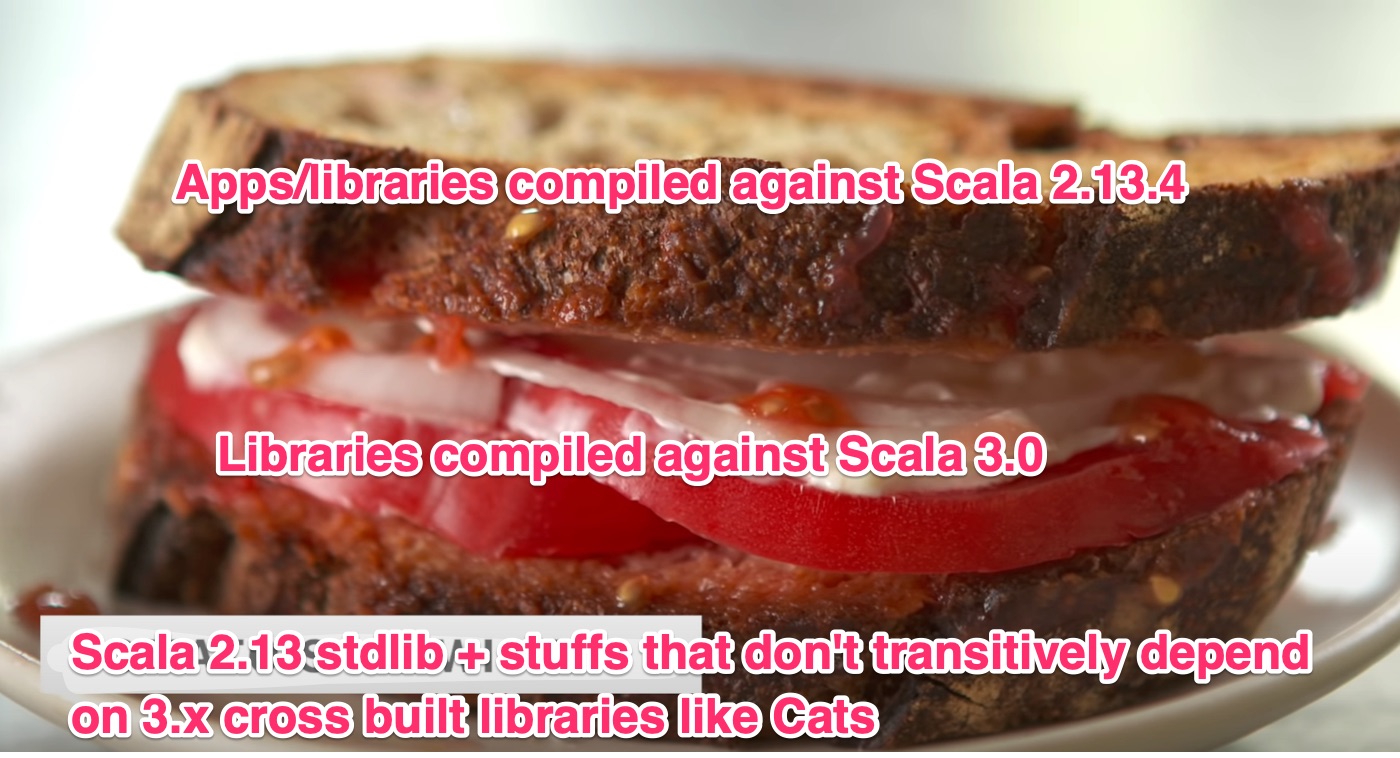
This is somewhat analogous to %% operator in a sense that scala-library started keeping the binary compatibility starting 2.9.x, and sbt added a mechanism to allow end users to take advantage of the compatibility. For Scala 2.13, forceScalaVersion remained in effect, so scala-library, -reflect, and -compiler versions aligned.
Background 3: SIP-51 Unfreeze scala-library (2024)
In 2024, @lrytz contributed sbt#7480, which removed forceScalaVersion so scala-library can be discovered from the classpath. As a substitute mechanism Lukas introduced csrSameVersions constraint, which forced scala-library, -reflect, and -compiler versions to be the same version. This combined with the build-time error to enforce that scalaVersion is same or greater than the discovered scala-library version effectively kept the same power of enforcement as forceScalaVersion.
Background 4: Scala 3.8.1 ships its own scala-library (2026)
In 2026, Scala 3.8 shipped, and it started building its own scala-library in Scala 3.x. This means that if we go to Maven Central there is now Central Repository: org/scala-lang/scala-library/3.8.1 . However, it does not come with scala-reflect or scala-compiler (Scala 3 compiler is called scala3-compiler_3).
Error downloading org.scala-lang:scala-reflect:3.8.1
Recall that we have Scala 2.13-3.x sandwich, which allows interoperability of Scala 2.13 and 3.x ecosystem. When a subproject using 2.13.x started using a Scala 3.8.x library via for2_13Use3, the csrSameVersions constraint kicked in, attempting to align scala-library:3.8.1 with scala-reflect, and caused ResolveException (sbt#8533) :
[error] (projectC / update) sbt.librarymanagement.ResolveException: Error downloading org.scala-lang:scala-reflect:3.8.0
[error]   not found: https://repo1.maven.org/maven2/org/scala-lang/scala-reflect/3.8.0/scala-reflect-3.8.0.pom
Unmoored scala-reflect and scala-compiler
To workaround the scala-reflect “not found” issue, in sbt 1.12.1 I’ve dropped the csrSameVersions constraint for Scala 2.13. This should allow the use of Scala 3.8.x libraries on Scala 2.13 subprojects, but at the same time, the resolution now behaves in a strange way.
Problem 1: ClassNotFound: scala.reflect.internal.tpe.TypeMaps$ContainsAnyCollector
[info]   Cause: java.lang.ClassNotFoundException: scala.reflect.internal.tpe.TypeMaps$ContainsAnyCollector
[info]   at java.base/jdk.internal.loader.BuiltinClassLoader.loadClass(BuiltinClassLoader.java:641)
[info]   at java.base/jdk.internal.loader.ClassLoaders$AppClassLoader.loadClass(ClassLoaders.java:188)
[info]   at java.base/java.lang.ClassLoader.loadClass(ClassLoader.java:526)
[info]   at scala.tools.nsc.typechecker.Typers$Typer.<init>(Typers.scala:211)
In the reported case, scala-compiler and scala-reflect on the classpath were downgraded from 2.13.18 to 2.13.14 and 2.13.16.
Problem 2: JLine was compiled by a more recent version
An exception or error caused a run to abort: org/jline/terminal/impl/ffm/CLibrary$termios has been compiled by a more recent version of the Java Runtime (class file version 66.0), this version of the Java Runtime only recognizes class file versions up to 65.0
  java.lang.UnsupportedClassVersionError: org/jline/terminal/impl/ffm/CLibrary$termios has been compiled by a more recent version of the Java Runtime (class file version 66.0), this version of the Java Runtime only recognizes class file versions up to 65.0
  at java.base/java.lang.ClassLoader.defineClass1(Native Method)
This strange error is also related likely to scala-compiler downgrading since scala-compiler 2.13.15, depended by refine library, brings in different version of JLine from that of scala-compiler 2.13.18.
Discussion: What should we do?
- Scala 2.13-3.x sandwich may have been useful during the initial introduction of Scala 3.x, but I’m now wondering if I should revert sbt#8633 and reintroduce
csrSameVersions, and effectively drop the sandwich support for 3.8+. I am actually not even sure if Scala 2.13 macros can safely execute using Scala 3.8.1 scala-library. - Not having the alignment of scala-library, scala-reflect, and scala-compiler on Scala 2.13 causes confusing issues.
- If some folks are truly inclined to use Scala 3.8.x libraries from 2.13 application, they could manually drop
csrSameVersions, and also deal with strangeness if they have to.